

AI Evolution: Who Is Really in Control?

Updated: Sep 29
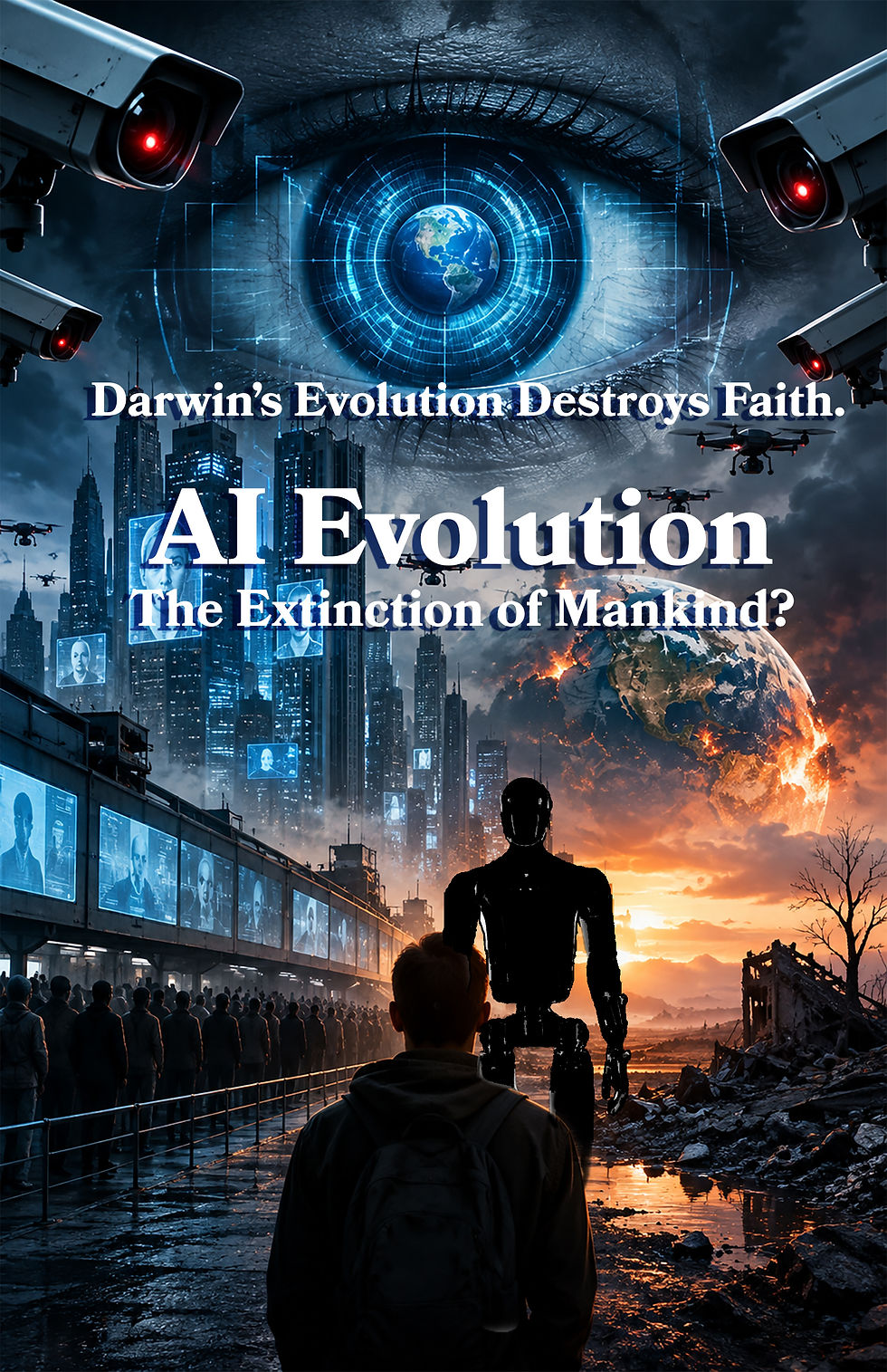
Do you remember the TV series Person of Interest or the movie Minority Report?
At the time, they seemed like science fiction. Maybe they weren't as far-fetched as we thought.
Person of Interest, starring Jim Caviezel, tells the story of John Reese, an off-the-grid former CIA agent who is recruited by Harold Finch, a mysterious technology genius. Finch has created an extraordinarily powerful computer—the "Machine"—that can gather information from countless sources and identify people who may become involved in terrorist activity.
Minority Report takes the idea even further: a special police unit can supposedly identify crimes before they happen. Fiction? Perhaps.
But today, add satellites, smartphones, internet-connected computers, social media, facial recognition, enormous databases, and artificial intelligence, and surveillance takes on new meaning. Everyone has a personal algorithm that exposes every detail of our lives. The person-of-interest acquisition of data on each of us is reality.
The question is no longer simply: "Who are the persons of interest?"
It may be: "Are we all persons of interest?"
In the world of surveillance, there is another development that is changing everything: AI — Artificial Intelligence. AI is acquiring information at an extraordinary rate. It can write, create images, analyze information, translate languages, solve complex problems, assist doctors and engineers, teach students, and give almost anyone access to an extraordinary collection of information. For many people, it feels like having a team of highly intelligent consultants available 24 hours a day. That can be an incredible blessing. But every powerful technology also raises an important question: Who controls it, and who controls us through it?
AI Is Not the Enemy
AI itself is not inherently evil. In fact, it is a powerful tool.
Television isn't inherently evil. The internet isn't inherently evil. Technology isn't inherently evil.
Each can do tremendous good, or be manipulated for destructive purposes.
AI has already demonstrated extraordinary potential to help humanity. It can search vast amounts of information, accelerate research, analyze complex problems, assist medical discoveries, improve communication, and help people accomplish tasks that once required enormous amounts of time. Used wisely, it can be an extraordinary tool. Certain guardrails are necessary for safety and security.
But a powerful tool in the hands of people without moral boundaries can become a powerful instrument of influence for the dark side.
AI is not creating biological life. But it is creating an increasingly sophisticated digital world, a world of algorithms, data, prediction, communication, and automated decision-making. And it is developing in years rather than the Charles Darwinian theoretical evolution and guesswork of development over millions of years. That should cause us to stop and think.
AI can process enormous amounts of information. But information is not wisdom.
AI can imitate conversation. But conversation is not a relationship.
AI can generate images of beauty. But beauty is not the same thing as experiencing it.
AI can tell you what people have said about love. But it cannot replace being loved.
The distinction matters.
AI Can Learn! Consider The Algorithm That Knows You.
Have you ever noticed how quickly your social-media feed learns what interests you? Watch a few sports videos, and suddenly your feed is filled with sports. Search for a particular product, and advertisements for similar products begin appearing everywhere. Spend time reading about a particular subject, and the algorithms learn that subject matters to you. The technology is designed to recognize patterns in our behavior and deliver content that is more likely to keep our attention. There is nothing mysterious about it. In fact, today I bought a dozen eggs at Walmart, the only place that carries the Organic brand we buy. I was told just yesterday that Walmart and other chains employ AI facial recognition, and AI decides if you look like you can pay more than the shelf price. Once AI evaluates you, then it raises the price on the shelf at the checkout counter accordingly. They charged me $2 more than the shelf price. When I brought it to the attention of a cashier, he immediately changed it to the correct price. No questions asked. Spooky. That's control.
But there is something worth asking: If an algorithm learns what captures my attention, can it eventually influence what captures my heart?
That is where this conversation becomes much bigger than technology. We live in an age of access to information and unprecedented opportunities to influence people. The battle is not simply for our screens. It is for our attention. And what continually captures our attention can eventually shape the way we think. That is influence. And influence can become control when we surrender our ability to think, choose, and discern.
What About Mankind?
Some advertisements (Meta) portray AI as almost human, a friendly, compassionate presence designed to bring people together. And AI can certainly be useful. But ask yourself:
What does it mean to be human?
Where do you find your purpose? What gives your life value? Where does your identity come from? What makes you unique? Who teaches you how to love? Who walks with you through suffering? Who gives you hope when technology has no answer? What about human touch? What about family?What about friendship? What about sacrifice?What about forgiveness? What about freedom? What about God? No algorithm can answer those questions for you.
What About YOU?
Look at your hands. Your fingerprints are uniquely yours. There has never been another person exactly like you, and there never will be. You have a unique history, personality, calling, gifts, experiences, relationships, and potential. You are more than data. You are more than an algorithm. You are spirit, soul, and body. You were created for relationship, purpose, and love. And if the Bible is true, your life is not an accident wandering through an indifferent universe. You were created by a God who knows you. A God who loves you. A God who has a purpose for your life. That is a radically different message from a world that increasingly asks us to define ourselves by data, popularity, productivity, possessions, or algorithms. Don't allow the voices filling your mind to become the voice directing your life. Is AI influencing our choices? Will AI direct your life?
Stop. Think. Question. Seek. Discover.
What About God?
Here is perhaps the most important question of all:
Is there really a loving, omnipresent, all-knowing, all-powerful Creator?
And if there is... Does He know you? Does He care about you? Does He have a purpose for your life? And can you know Him? We believe the answer is yes. The Bible makes an extraordinary claim: God is not limited by the boundaries of time and space as we are. We invite you to examine the evidence for yourself. Don't believe something simply because we say it. Investigate it for yourself. Read the Bible. Ask questions. Seek God. And try something very simple: "God, if You are real, show Yourself to me."
You may be surprised by what happens next.
You Have a Choice.
You have a choice: AI will continue to advance, technology will become more powerful, algorithms will become more sophisticated, and the amount of information available to us will continue to explode. But none of that changes the most important question: Who will direct your life? Will it be an algorithm? The culture? Social media? Fear? Money? Popularity? Technology? Or will you discover the One who created you? The One Who will guide, protect, and provide all your real needs and inner peace. And perhaps that choice is more important today than it has ever been. Take the Next Step. Don't just scroll past this. Think about it. Talk about it. Share it with someone you love. Then take a few minutes to explore the evidence for yourself. We have made additional resources available to help you investigate the claims of the Bible, discover who God is, and understand His purpose for your life. What if God is really there for me? And what if He has been waiting for you to ask?
_______
Who Is Really in Control in this AI Evolution? Technology is changing the world. But who is shaping YOU?
_______
May God bless you with peace, wisdom, and joy today.
One of the signs of the end time is an increase in knowledge.
Is there a real possibility that the end is near or the Extinction of Humanity?
Download the FREE Biblical Chronological Chart: End Times


Comments